Single π0 electro-production at high Q2 in the Delta resonance region
We report the analysis of exclusive single π0 electro-production in the Δ(1232)
resonance region at Jefferson Lab in the Q2 range 2.4 → 6 GeV2.
π0 c.m. angular distributions are obtained over the entire 4π c.m.
solid angle and the c.m. differential cross section is measured.
The GM* form factor and multipoles ratios REM = E1+ / M1+ and RSM = S1+ / M1+ for
the Δ(1232) resonance production are extracted using both a truncated multipoles
analysis and the JANR unitary isobar model.
Cross Sections, Structure Functions and Legendre Coefficients Distributions
Main Results:
With high enough energy we expected to ‘see’ past the mesons / gluons cloud and be able to probe directly the quarks in
the Δ(1232) resonance. This is clearly not the case at these energy: the meson/gluon contribution
is still too strong, and unknown.
| |
|
|
 |
|
 |
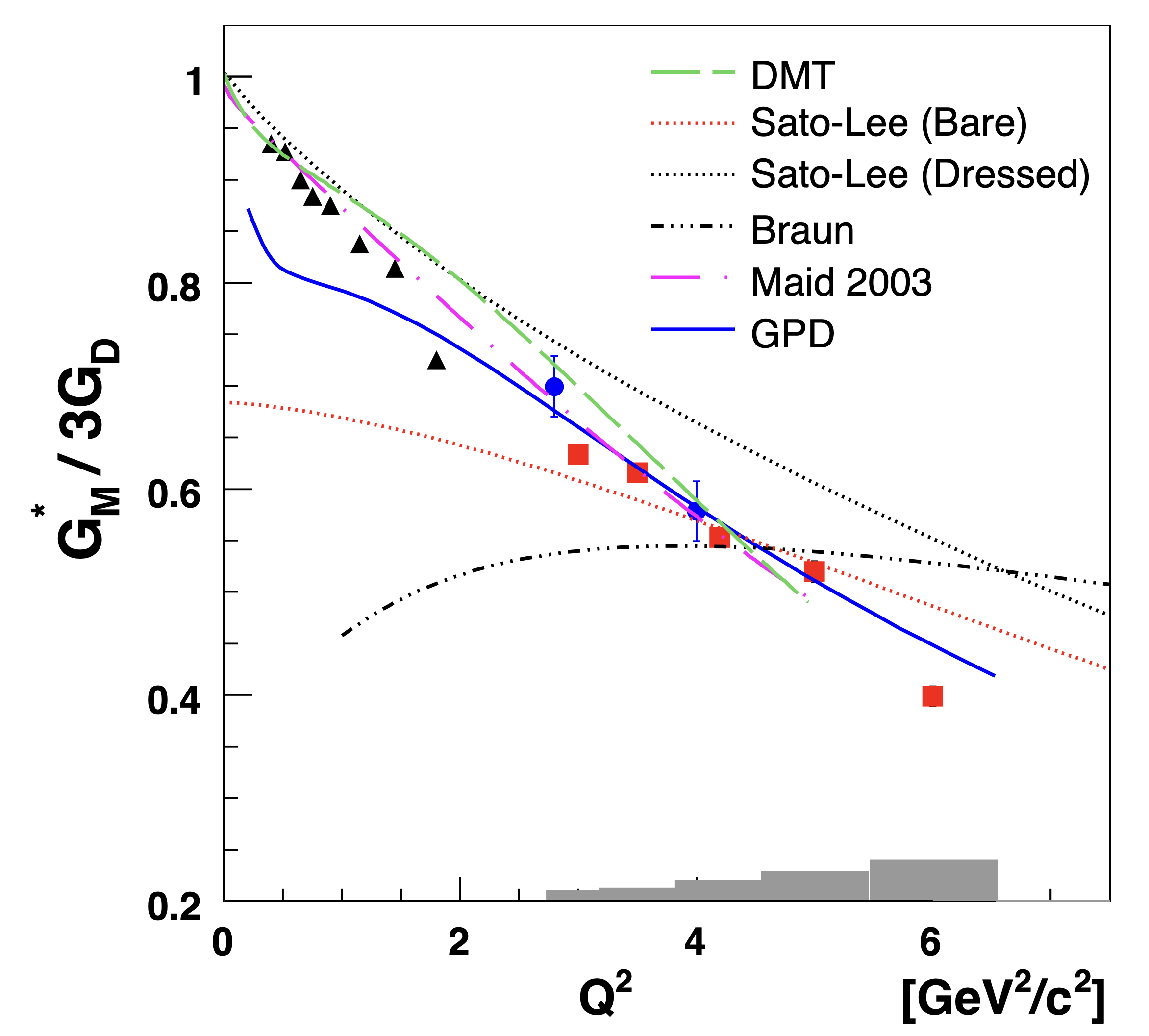
The Form Factor GM*/3GD. The filled red squares are from the current CLAS experiment utilizing the Unitary Isobar Model (UIM). The errors shown are statistical, while estimated systematic errors are shown as gray bars at the bottom of the graph. Also shown are selected earlier published results. The filled triangles correspond to a recent analysis of previous CLAS data and the filled circles are from an earlier JLab Hall C experiment.
Bottom Line The magnetic form factor GM* decreases with Q2 faster than the elastic magnetic form factor.
ELI5 In general particles sizes decrease as the probe energy increase, typically like the proton. For some unknown reason, the Δ(1232) resonance size becomes smaller a lot faster.
|
|
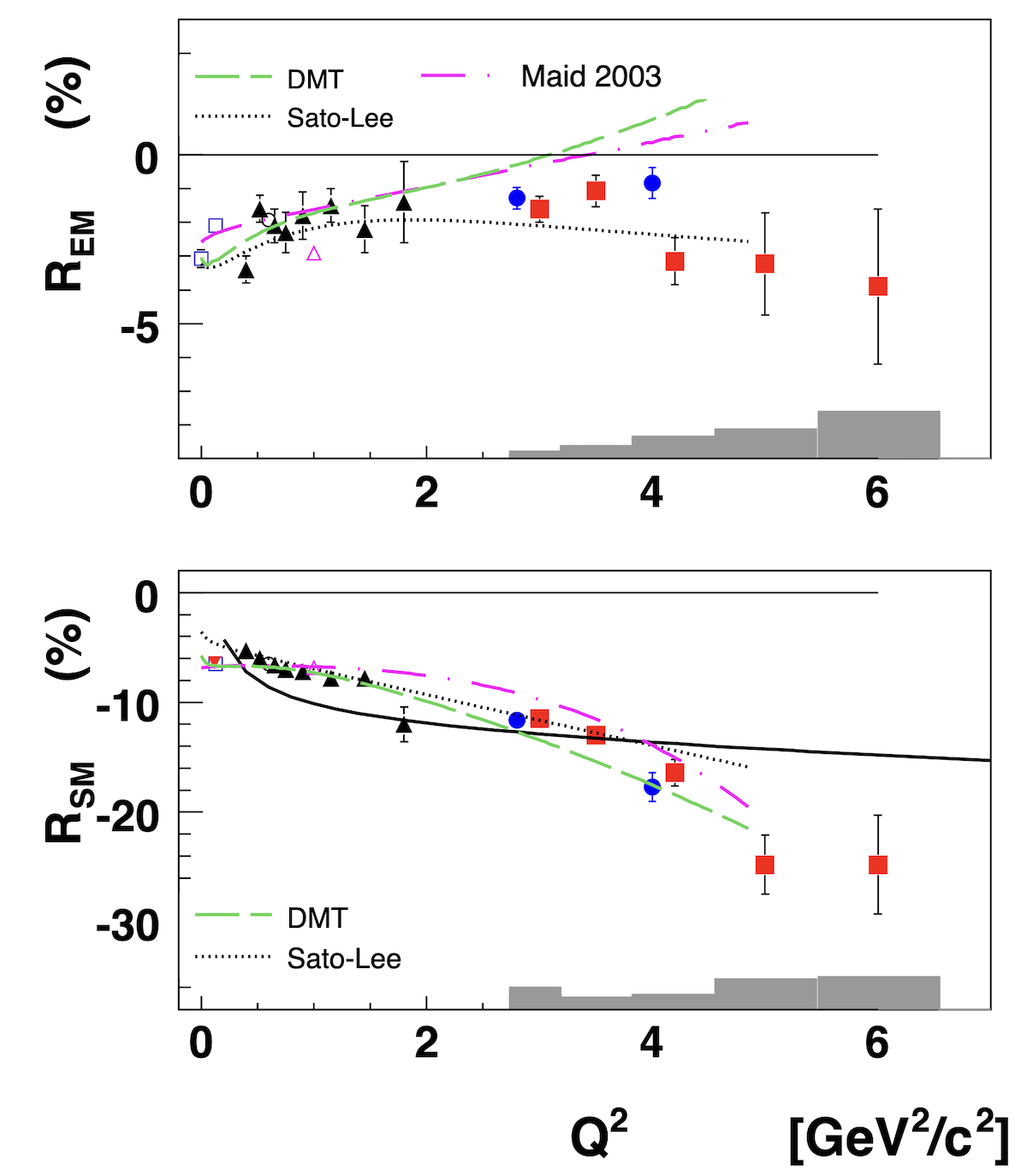
The ratios REM (upper panel) and RSM (lower panel). The filled red squares are from the current CLAS experiment utilizing the UIM. The errors shown are statistical, while estimated systematic errors are shown as gray bars at the bottom of the graph. Also shown are selected earlier published results. The filled triangles correspond to a recent analysis of previous CLAS data and the filled circles are from an earlier ]Lab Hall C experiment.
Bottom Line REM is small and negative, while RSM remains negative and increases in magnitude. These results confirm the absence of pQCD scaling at these kinematics and suggest large helicity non-conservation.
ELI5 At these energies, we cannot use pQCD to describe the Δ(1232) resonance: the contributions from quark and gluons interactions is just too strong, and unknown.
|